Corky Marlinson
Deception PointCorky Marlinson is a prize-winning astrophysicist whose specialist knowledge helps Rachel Sexton and Michael Tolland assess the evidence behind NASA’s claimed meteorite discovery. A civilian recruit in the President’s investigation, he begins as a forceful advocate for the rock’s authenticity; as contrary evidence builds, his insistence on weighing proof rather than hunches becomes central to the group’s reassessment. He survives the attack on the investigators and the later escape from the Goya, reaching the White House with Rachel and Tolland.
Identity and Introduction
Marlinson is a recipient of the National Medal of Science and is renowned among National Reconnaissance Office satellite engineers for his work on gravitational fields. Rachel is surprised to learn he is among the President’s civilian recruits. Tolland, who attended Princeton graduate school with him, recalls Marlinson as a man who could get lost in his own dormitory; the contrast between this absent-minded reputation and his scientific distinction gives the expert a comic, human edge without diminishing his authority.
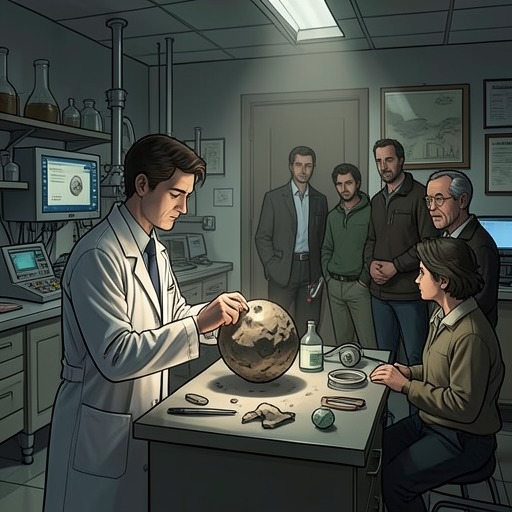
When Rachel and Tolland find him at work, Marlinson ushers them into his work area and sorts through tools and rock samples. His restless, tightly coiled manner accompanies the practical business of examining material: he is not introduced as a distant authority but as a working scientist handling evidence alongside the others.
Examining the Meteorite
Marlinson’s analysis helps establish why the meteorite initially appears so persuasive. Rachel examines a rock sample under bright overhead lights and sees tiny metallic globules, each about a millimeter across, distributed through its cross-section. Marlinson also produces a large folded sheet from a manila envelope as he lays out further material for the investigation. His enthusiasm for the broader implications surfaces in his identification of panspermia, the possibility that life can travel between worlds.
He links the sample’s core dates with the historical record, arguing that their agreement is virtual proof that it is a fragment of the meteorite Jungersol recorded seeing in 1716. The claim gives the discovery a history extending beyond the immediate NASA operation: the apparent match between a physical specimen and an old record is part of the case Marlinson believes supports its authenticity.
That confidence becomes explicit when the possibility of a fake is raised. Marlinson points to professional examination, chemical scans, spectrography, rubidium-strontium dating, and the rock’s apparent difference from anything previously seen on Earth. He cites its fusion crust, chondrules, and unusual nickel ratio. At one point he produces a disc-shaped stone sample for the camera, turning his argument into a visible demonstration rather than an appeal to reputation alone.
Evidence, Doubt, and Reassessment
Marlinson’s position is tested as the group revisits its assumptions. After Tolland considers what the evidence might mean without treating the meteorite’s authenticity as a premise, he and Rachel discuss the implications with a groggy Marlinson. On the flight south along the Canadian coast of the Gulf of St. Lawrence, Marlinson’s admission that the nickel content falls outside pre-established midrange values helps rekindle Rachel’s suspicion that the meteorite may have been secretly planted as part of a carefully designed fraud.
He resists returning too quickly to the fake-meteorite explanation. When Rachel and Tolland continue to weigh troubling evidence, Marlinson objects that science should be based on evidence rather than hunches. He considers the chondrules decidedly meteoric and argues that the evidence supporting authenticity remains conclusive while the opposing case is circumstantial. His position is not simply stubbornness: the chondrules are the remaining piece of evidence that still categorically supports NASA’s claim, and Rachel acknowledges their importance even as her doubts deepen.
This tension makes Marlinson’s expertise both an asset and a vulnerability. The same concrete features that justify his confidence also leave him confronting evidence that does not fit neatly with the original conclusion. The novel places his professional certainty against Rachel’s growing suspicion, making the investigation turn on whether an apparently powerful chain of scientific indicators can survive a broader change in the question being asked.
Attack, Escape, and Survival
During the assault on the investigators, Marlinson is knocked down and later tries to sit up. A soldier pins his arms to the ice, leaving him in pain; Rachel subsequently sees him moving nearby, visibly injured. The attack interrupts the scientific inquiry with immediate physical danger, but Marlinson remains part of the group’s effort to survive.
Aboard the Goya, he eventually reaches a Crestliner Phantom 2100 and drives it away at full throttle. With Rachel and Tolland trapped on the catwalk and beyond his reach, he makes a rapid decision to draw the helicopter after him. He is wounded in the leg during the escape, but recognizes that the boat can continue in a straight line without him at the helm. Later, rescuers find him in the water near burning wreckage and bring him aboard; he is naked except for duct tape covering one leg. His apparent loss is reversed when Tolland spots him alive in the doorway of the rescue aircraft, while Rachel is being hauled to safety.
Recovery and Narrative Role
The Coast Guard aircraft transports Marlinson, Tolland, and Rachel from the Washington Monument to the White House at the President’s command. They are given breakfast, examined by doctors, and offered rooms in which to recover. Marlinson later hobbles down a hallway on crutches, his leg professionally bandaged, and tells Rachel he could not sleep either. Even while injured and exhausted, he returns to scientific speculation, discussing how urine and the olfactory lobes might provide a key to identifying what is present.
Marlinson’s arc joins scientific authority to the limits of scientific certainty. His defense of the meteorite rests on specific tests and features, not mere loyalty to NASA; when those facts are challenged, the disagreement exposes how an accepted premise can shape the reading of every subsequent observation. His persistence through the attack and escape also makes him more than an expert witness: he is a participant in the investigation whose technical curiosity survives the apparent collapse of the case and the ordeal that follows.